This website requires Javascript for some parts to function propertly. Your experience may vary.

The Ultimate Guide to Automotive Ethernet | STAR ELECTRONICS

The Ultimate Guide to Automotive Ethernet: from basics to integration

Automotive Ethernet is redefining in-vehicle communication, surpassing traditional protocols like CAN and FlexRay in both speed and scalability. As modern vehicles evolve into data-driven platforms - supporting Advanced Driver Assistance Systems (ADAS), autonomous driving features, and connected infotainment - Ethernet has emerged as the backbone of next-generation automotive architectures. It delivers high bandwidth, low latency, and seamless integration for complex networks that handle massive data streams from multiple sensors, cameras, and control units.

What is Automotive Ethernet and why does it matter?

Traditional in-vehicle communication standards such as CAN and FlexRay were designed for low-bandwidth signals like sensor readings or control messages. However, with the rise of high-resolution cameras, LiDAR, radar systems, and infotainment, the data demands have far exceeded the capacity of these legacy protocols.

Automotive Ethernet solves this challenge by providing:

  • High data throughput (from 100 Mbps up to 10 Gbps with current standards)

  • Low latency, essential for real-time decision-making in ADAS and autonomous driving

  • Scalability and flexibility, as Ethernet networks can grow to accommodate new modules and functions without requiring complete redesign

Built upon the OSI model’s Physical Layer (Layer 1) and Data Link Layer (Layer 2), Automotive Ethernet ensures interoperability with standardized communication frameworks while meeting the stringent requirements of automotive environments, such as electromagnetic compatibility and resistance to harsh conditions.
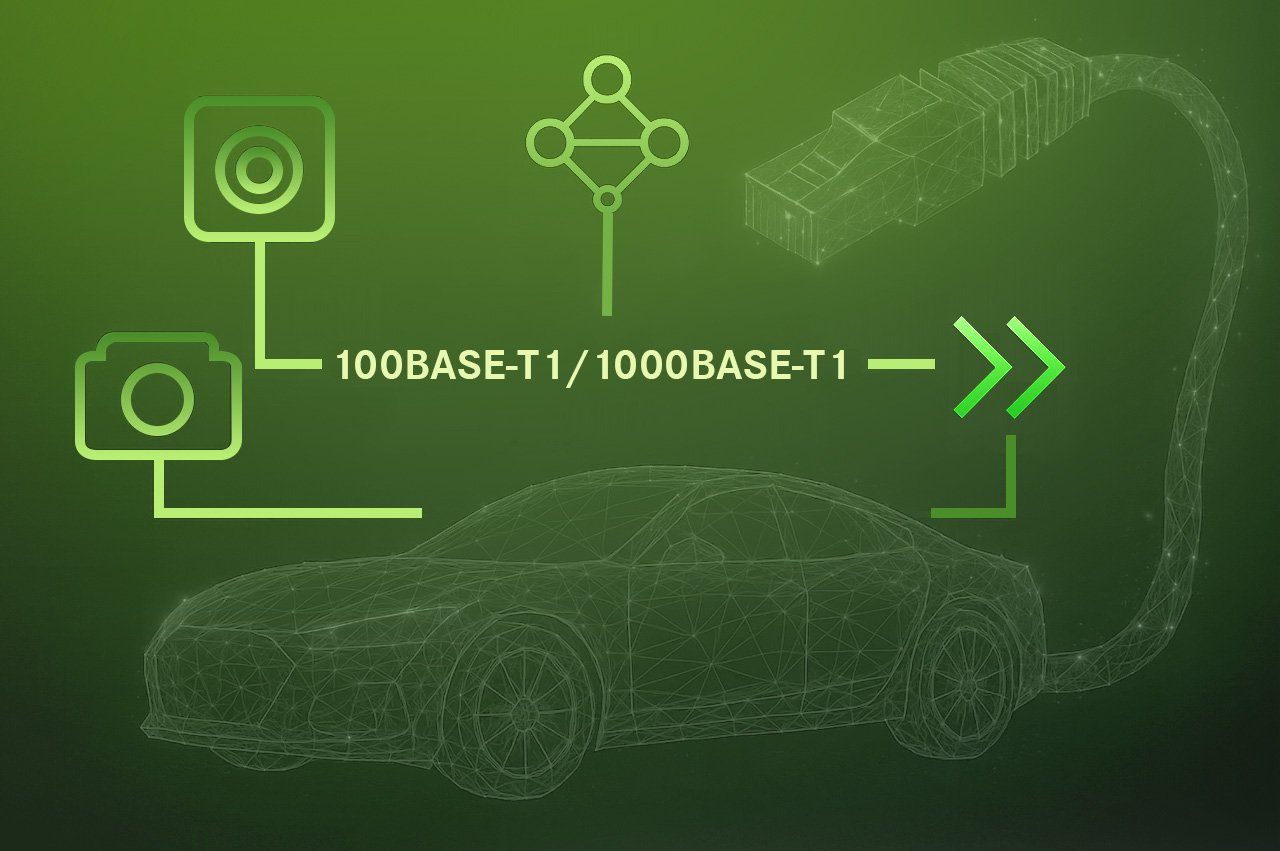
Core Standards: 100BASE-T1 and 1000BASE-T1

The foundation of Automotive Ethernet lies in its specialized standards:

  • 100BASE-T1:
    Designed for 100 Mbps communication over a single unshielded twisted pair (UTP). It reduces both the weight and cost of cabling compared to traditional Ethernet, making it ideal for medium-bandwidth applications such as camera connections or sensor data streams.

  • 1000BASE-T1:
    Supports data rates up to 1 Gbps, which is critical for data-heavy applications like multi-camera ADAS systems, high-resolution infotainment, and central gateway communication.

Both standards incorporate advanced electromagnetic interference (EMI) protection and are optimized for long cable runs, which is crucial in the distributed architecture of modern vehicles.

Connectors and Network Topologies

Automotive Ethernet networks often use:

  • Star topologies, connecting multiple ECUs to a central switch or gateway

  • Daisy-chain or bus topologies, ideal for connecting devices in series with minimal cabling

Automotive connectors differ from conventional Ethernet (RJ45). They are smaller, rugged, and designed to withstand high vibration, temperature extremes, and moisture. Examples include H-MTD and MATEnet connectors, commonly used for 100BASE-T1 and 1000BASE-T1 networks.

Advantages of Automotive Ethernet Over CAN and FlexRay
  1. Higher bandwidth: CAN supports speeds up to 1 Mbps and FlexRay up to 10 Mbps, while Automotive Ethernet starts at 100 Mbps and scales up to 1 Gbps or more

  2. Standardized technology: Built on well-established Ethernet standards, reducing complexity and cost

  3. Convergence of networks: A single Ethernet backbone can handle both control and multimedia data

  4. Future-proofing: Supports emerging technologies like Time-Sensitive Networking (TSN) and Power over Ethernet (PoE)

Real-World Applications
  • Electric Vehicles (EVs): Managing battery systems, enabling energy-efficient communication (802.3az), and supporting fast OTA (over-the-air) updates

  • ADAS and autonomous driving: Centralized ECUs process terabytes of data from cameras, radars, and LiDAR sensors

  • Infotainment systems: Seamless streaming, real-time navigation, and high-definition media across multiple screens

  • Central gateway and zonal architectures: Ethernet connects different zones of the vehicle to a centralized brain, simplifying network design

STAR ELECTRONICS provides hardware and software solutions that supports these use cases, including gateways, probes, Automotive Ethernet PHY modules, T1 media converters, and evaluation boards optimized for testing ADAS and EV platforms.

Explore the full product line: STAR ELECTRONICS Automotive Ethernet Solutions

Challenges and Considerations

While Automotive Ethernet offers many benefits, its implementation requires careful planning:

  • Compatibility with legacy systems: Transitioning from CAN or FlexRay may require media converters or gateways

  • Network security: Layer 2 security protocols like MACsec (802.1AE) are essential to protect data integrity

  • Latency-sensitive applications: TSN (Time-Sensitive Networking) ensures deterministic performance for real-time systems

Future Trends in Automotive Ethernet

The future points toward multi-gigabit Ethernet (2.5G, 5G, and 10GBASE-T1), which will power fully autonomous driving and vehicle-to-everything (V2X) communication. Integration with AUTOSAR Ethernet stacks, combined with advanced safety and cybersecurity standards, will make Automotive Ethernet the undisputed standard for next-generation vehicle networks.

Glossary

Term

Definition

Automotive Ethernet

Ethernet-based communication standard for vehicles

CAN (Controller Area Network)

Legacy protocol for low-speed in-vehicle communication

FlexRay

High-speed automotive communication protocol, now largely replaced

ADAS

Advanced Driver Assistance Systems

LiDAR

Sensor technology using laser light for distance measurement

ECU (Electronic Control Unit)

Embedded system controlling vehicle functions

100BASE-T1 / 1000BASE-T1

Ethernet standards for single twisted-pair automotive communication

TSN (Time-Sensitive Networking)

Ethernet extension for deterministic data delivery

PoE (Power over Ethernet)

Technology for transmitting power and data over a single Ethernet cable

MACsec (802.1AE)

Security protocol for Ethernet at Layer 2

AUTOSAR

Standardized automotive software architecture

RJ45 / H-MTD / MATEnet

Types of Ethernet connectors used in automotive and industrial applications

Contact us

Back to top