This website requires Javascript for some parts to function propertly. Your experience may vary.

Which tool and process to use to validate your LIN Network? | STAR ELECTRONICS

Which tool and process to use to validate your LIN Network?

Step-by-step guide according to your environment

Whether you’re working in a high-end automotive lab or building a compact validation setup for pre-series testing, selecting the right toolchain and validation flow is critical to ensuring LIN Bus reliability and ISO 17987 compliance.

This step-by-step blueprint outlines the optimal validation process based on your environment so you can avoid compatibility issues, accelerate certification, and make confident, technically justified decisions.

Why You Need a LIN Validation Blueprint

LIN Bus validation is not a one-size-fits-all process. Each test environment—whether professional, prototyping, or hybrid—requires:

  • Specific transceivers and interface modules

  • Distinct workflows to simulate master/slave behavior

  • Accurate timing and frame verification tools

Without a structured approach, it’s easy to fall into redundant testing cycles or overlook protocol violations that compromise the integrity of your communication network.

What This Blueprint Covers

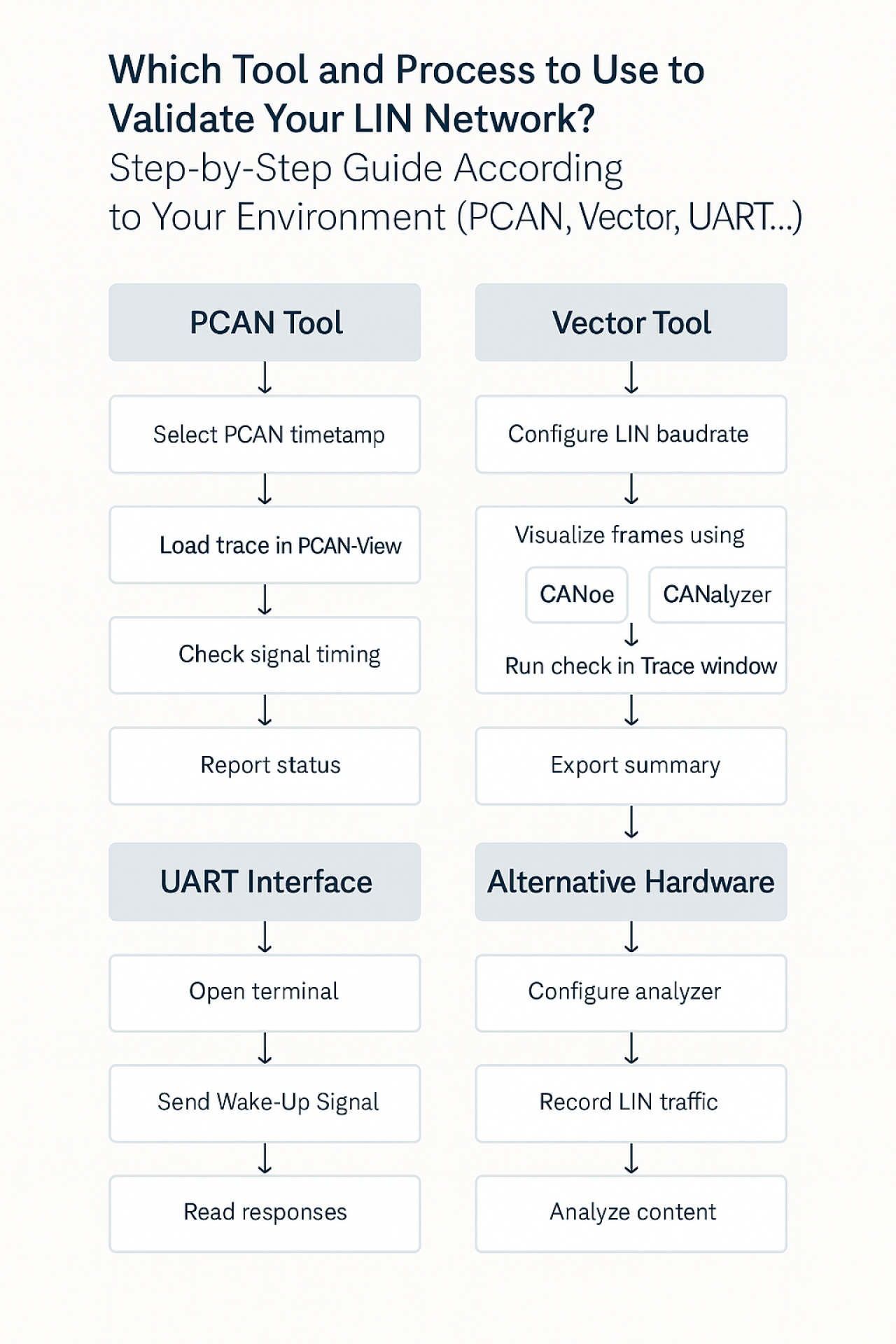
This visual guide outlines:

  • Tool selection by validation depth: From UART emulation to full CAPL-based simulation

  • Recommended flows: Sync Break detection, schedule table handling, fault injection

  • Hardware/software combos: What works best with each interface and why

  • Test examples: What you can validate and how—from signal levels to full-frame diagnostics

Blueprint
STAR ELECTRONICS Supports Your Validation Flow

Whether you’re using Vector VN1630A, PCAN-LIN, or a custom UART setup with MCP2004, STAR ELECTRONICS offers:

  • Fully compatible hardware (transceivers, breakout boards)

  • LIN simulation and testing accessories

  • Technical support for integration and tool configuration

Explore our LIN validation components

Glossary

Term

Definition

LIN (Local Interconnect Network)

Serial communication protocol used in automotive systems for low-speed control

ISO 17987

International standard defining LIN protocol specifications

UART (Universal Asynchronous Receiver/Transmitter)

Serial communication interface used in microcontrollers

MCP2004

LIN transceiver IC used in low-cost LIN implementations

PCAN-LIN

LIN interface from PEAK-System for message simulation and monitoring

Vector VN1630A

High-end multi-bus interface supporting LIN, CAN, and FlexRay

CAPL

Scripting language used in Vector tools for simulation and automation

Schedule Table

Predefined timing structure for LIN communication

Sync Break

Start signal in a LIN frame indicating the beginning of communication

Fault Injection

Technique used to simulate errors and test system robustness

Contact us

Back to top