This website requires Javascript for some parts to function propertly. Your experience may vary.

PoE in Automotive: How to choose between 802.3af, .at and .bt | STAR ELECTRONICS

PoE in Automotive: 802.3af, 802.3at, 802.3bt – Which standard to choose?

Power over Ethernet (PoE) is transforming how automotive networks are designed. By enabling both data and power transmission through a single Ethernet cable, PoE reduces wiring complexity, lowers vehicle weight, and simplifies integration of critical in-vehicle systems such as cameras, ECUs (Electronic Control Units), LiDAR systems, and advanced sensors.

In automotive environments where space and reliability are essential, selecting the right PoE standard is crucial for safe and efficient operation.

Overview
Understanding the PoE Standards

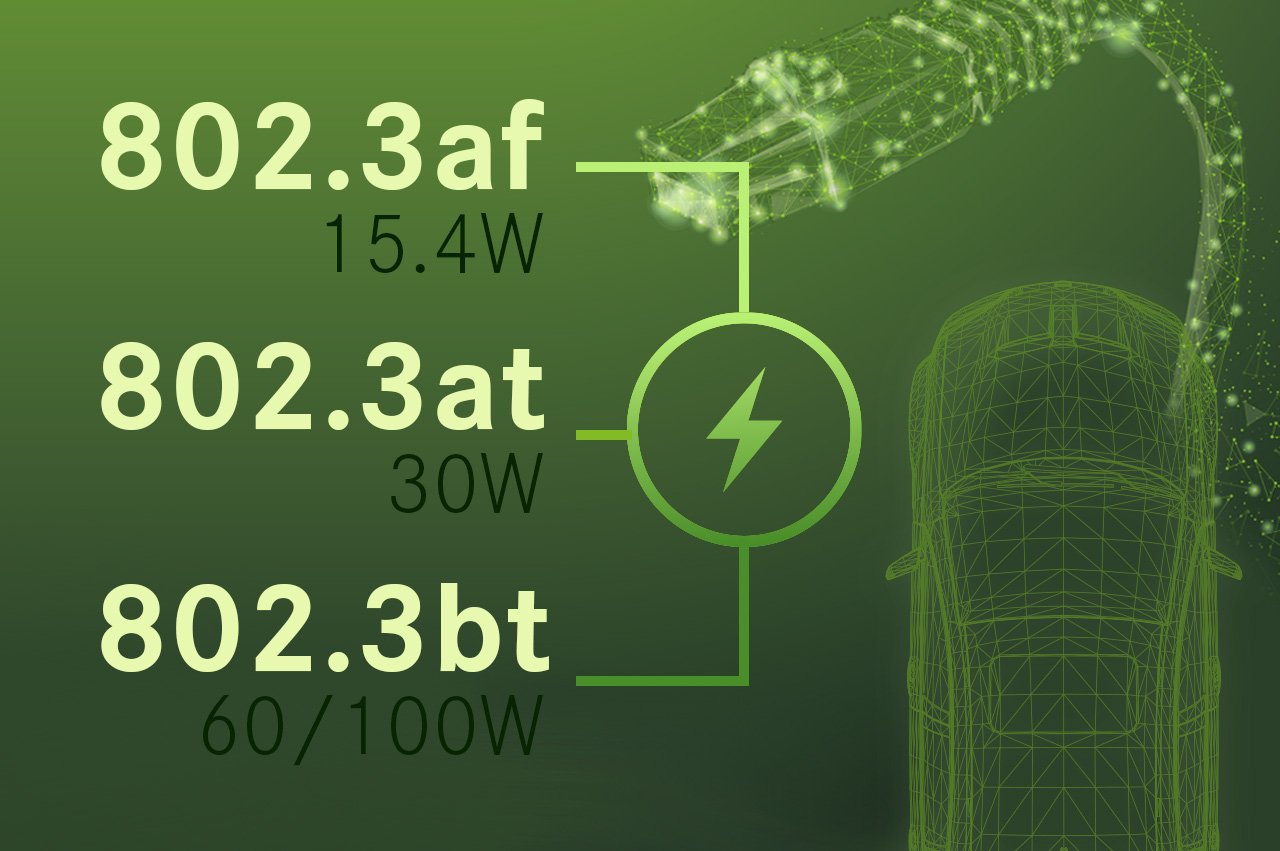
PoE standards are defined by the IEEE 802.3 family, each supporting different power levels and use cases:

  • 802.3af (PoE):
    Provides up to 15.4 watts of power, suitable for low-power sensors, IP cameras, or basic ECUs. Commonly used in entry-level ADAS modules or small infotainment components.

  • 802.3at (PoE+):
    Delivers up to 30 watts, supporting more advanced ECUs, LiDAR systems, and in-vehicle gateways. Ideal for devices with higher data and power demands.

  • 802.3bt (PoE++):
    Offers between 60 and 100 watts, designed for high-resolution cameras, high-performance computing units (HPCs), and network gateways requiring both power and high-speed data transfer.

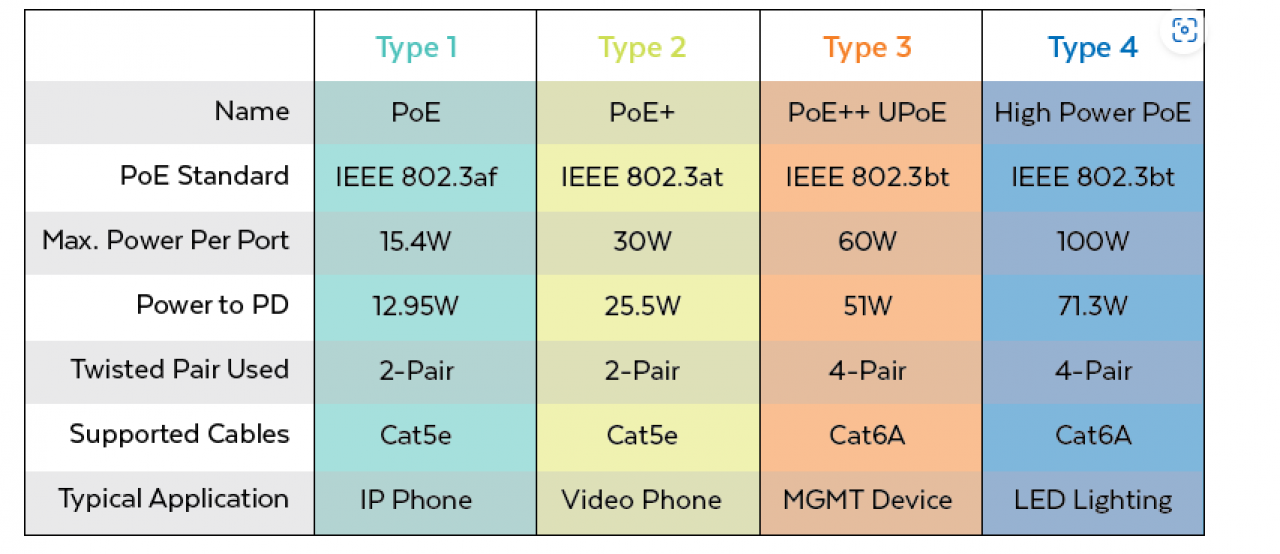
*IEEE 802.3bt Type 4 (Hi-PoE) - Planet Technology USA

Why PoE Matters in Automotive Applications

Traditional vehicle wiring for power and data can be bulky and expensive, especially as modern vehicles integrate dozens of cameras, sensors, and ECUs. By combining power and data into a single cable:

  • The wiring harness is simplified, reducing weight and improving energy efficiency (especially important in electric vehicles).

  • Components can be placed more flexibly, without being constrained by separate power lines.

  • Maintenance becomes easier due to fewer connections and potential failure points.

However, choosing the wrong PoE standard can result in overloading, underpowering, or damaging sensitive automotive components.

Compatibility and Safety Considerations

When integrating PoE into automotive Ethernet networks:

  • Ensure that your camera, ECU, or sensor supports the selected PoE class (e.g., Class 0–4 for 802.3af/at).

  • Use automotive-certified PoE injectors or switches designed to withstand harsh conditions (vibration, electromagnetic interference, and temperature variations).

  • Choose components with strong EMC shielding and overcurrent protection to prevent device damage.

Practical Recommendations for Engineers
  1. Match the power class to device requirements:
    Check the power consumption of your cameras or ECUs and select the appropriate PoE standard.

  2. Combine PoE with media converters for hybrid environments:
    When connecting traditional Ethernet devices to T1 networks, a media converter with PoE support ensures compatibility for both power and data.

Key Takeaway

Choosing the right PoE standard is not just about power - it’s about building a safe, efficient, and future-proof automotive network. With 802.3af, 802.3at, and 802.3bt, engineers can select the best fit for each application, from low-power sensors to high-performance ECUs.

By leveraging STAR ELECTRONICS products, engineers can confidently design robust and automotive-ready Ethernet networks.

Glossary

Term

Definition

PoE (Power over Ethernet)

Technology that enables simultaneous transmission of power and data over a single Ethernet cable

ECU (Electronic Control Unit)

Electronic control module used in vehicles

LiDAR

Sensor technology that measures distance using laser light

IEEE 802.3

Family of standards for Ethernet technologies

ADAS (Advanced Driver Assistance Systems)

Systems that assist the driver in driving and parking functions

EMC (Electromagnetic Compatibility)

Ability of equipment to function properly in an electromagnetic environment

HPC (High Performance Computing)

Computing systems with high processing power for complex tasks

100BASE-T1 / 1000BASE-T1

Ethernet standards for automotive data transmission over single twisted-pair cables

FL3X

STAR ELECTRONICS product family for advanced automotive networking, simulation, and gateway applications

Contact us

Back to top