This website requires Javascript for some parts to function propertly. Your experience may vary.

Introduction to TSN for Automotive Ethernet | STAR ELECTRONICS

The complete introduction to TSN for Automotive Ethernet

Time-Sensitive Networking (TSN) is revolutionizing automotive communications by enabling deterministic, real-time data transmission over Ethernet networks. For next-generation vehicles—where systems like ADAS, autonomous driving modules, and infotainment demand flawless coordination—TSN ensures that data packets arrive on time, every time.

What is TSN and why is it critical?

TSN is not a single protocol but a suite of IEEE 802.1 standards that build upon the Ethernet Data Link Layer, adding guaranteed latency, synchronized timing, and traffic prioritization. This is crucial for modern vehicles, where even a brief delay in sensor communication could compromise the performance of safety-critical applications like emergency braking or lane-keeping.

Why Ethernet as a Foundation?

Unlike CAN or FlexRay, which are limited to small data packets, Automotive Ethernet (e.g. 100BASE-T1 and 1000BASE-T1) can handle high-bandwidth data streams - making it ideal for high-resolution cameras, LiDAR, and infotainment content. TSN adds the determinism that Ethernet traditionally lacks, bridging the gap between bandwidth and reliability.

The main TSN Standards you need to know

TSN comprises multiple sub-standards, each addressing a key aspect of real-time networking:

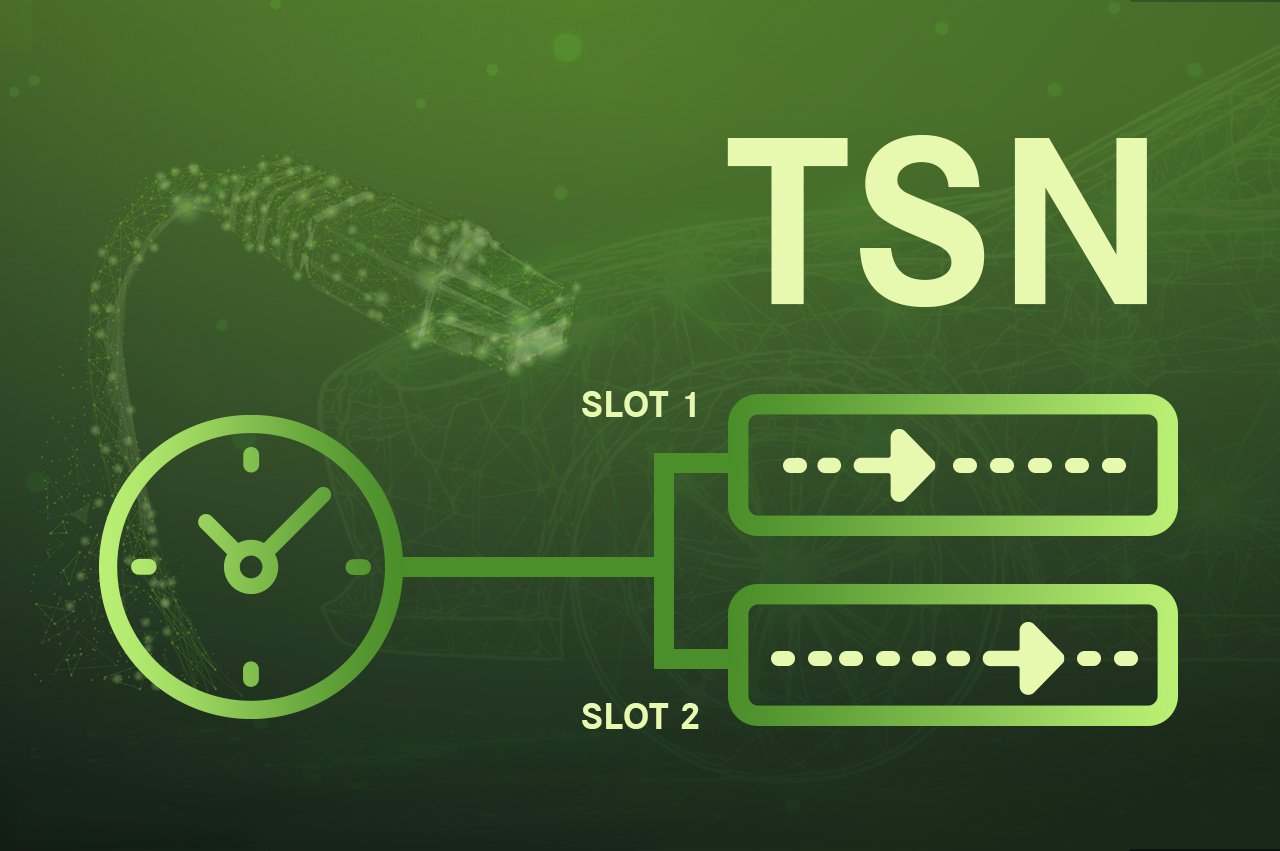
  • IEEE 802.1Qbv – Time-Aware Shaper: Enables scheduled traffic, guaranteeing bandwidth for critical frames like ADAS sensor data

  • IEEE 802.1AS – Timing and Synchronization: Provides network-wide time synchronization, essential for camera fusion and radar alignment

  • IEEE 802.1Qbu – Frame Preemption: Allows critical frames to bypass non-essential traffic, reducing latency spikes

  • IEEE 802.1CB – Seamless Redundancy: Delivers zero-packet-loss communication by duplicating data streams across paths

TSN in Automotive Applications
  1. ADAS and Autonomous Driving:
    LiDAR, radar, and camera sensors generate massive data streams that must be processed in real time for accurate decision-making

  2. Infotainment Systems:
    High-definition video and audio require low-latency delivery for seamless user experiences

  3. Central Gateways and Zonal Architectures:
    TSN facilitates the shift from multiple domain-specific networks to unified Ethernet-based backbones, reducing complexity and cost

TSN and the OSI Model

From a technical perspective, TSN operates mainly at the Data Link Layer (Layer 2), where it extends standard Ethernet protocols with time-aware scheduling and synchronization mechanisms. This aligns with the layered approach defined in the OSI reference model, ensuring interoperability and modularity.

Challenges and Considerations

Implementing TSN in the automotive domain requires:

  • TSN-capable hardware: Switches, controllers, and PHYs that comply with IEEE 802.1 standards

  • Precise synchronization: Integration with protocols like PTP (Precision Time Protocol) for clock alignment

  • Software frameworks: Compatibility with AUTOSAR and other automotive middleware

How STAR ELECTRONICS can help

STAR ELECTRONICS provides TSN-ready media converters, switches, and testing solutions that simplify integration into both development environments and production vehicles. By combining plug-and-play hardware with detailed technical documentation, STAR reduces complexity and accelerates validation.

Explore STAR ELECTRONICS’ TSN solutions: STAR ELECTRONICS Products

Key Takeaway

TSN is the enabler of deterministic Automotive Ethernet, ensuring reliable, real-time communication across critical vehicle systems. For engineers designing the future of mobility, mastering TSN is no longer optional - it’s essential.

Glossary

Term

Definition

TSN (Time-Sensitive Networking)

A set of IEEE standards for deterministic Ethernet communication

IEEE 802.1

Standard family defining TSN protocols

Data Link Layer (Layer 2)

OSI layer responsible for node-to-node data transfer

100BASE-T1 / 1000BASE-T1

Automotive Ethernet standards for single twisted-pair communication

CAN / FlexRay

Legacy automotive communication protocols

PTP (Precision Time Protocol)

Protocol for clock synchronization across network devices

AUTOSAR

Standardized automotive software architecture

Frame Preemption

TSN feature allowing priority traffic to interrupt lower-priority frames

Seamless Redundancy

TSN mechanism for zero-packet-loss communication

Time-Aware Shaper

TSN feature for scheduling traffic based on time slots

Contact us

Back to top