This website requires Javascript for some parts to function propertly. Your experience may vary.

How to connect Ethernet with 100BASE-T1 and 1000BASE-T1 | STAR ELECTRONICS

How to Connect Traditional Ethernet with 100BASE-T1 and 1000BASE-T1

Connecting conventional Ethernet networks with Automotive Ethernet (T1) is a common challenge for engineers integrating modern vehicle systems into existing infrastructures. Standards such as 100BASE-T1 and 1000BASE-T1 were specifically developed to meet the stringent requirements of the automotive industry, offering high data rates over a single twisted pair. However, they differ fundamentally from traditional Ethernet.

What Makes T1 Different?

While conventional Ethernet (e.g., 100BASE-TX or 1000BASE-T) typically uses two or four twisted pairs, T1 Ethernet operates with only one twisted pair - significantly reducing weight, space, and cost. This is a major advantage in vehicle design, where every gram and every cable matters.

Additional key differences include:

  • Improved EMI resilience: T1 networks are designed to withstand the harsh electromagnetic conditions inside vehicles.

  • Extended cable lengths: Depending on the usecase, T1 supports cable lengths of up to 15 – 40 meters.

  • Automotive optimization: Fully compliant with 100BASE-T1 (100 Mbps) and 1000BASE-T1 (1 Gbps), suitable for ADAS cameras, ECUs, and infotainment systems.
Why Media Converters and Switches are essential

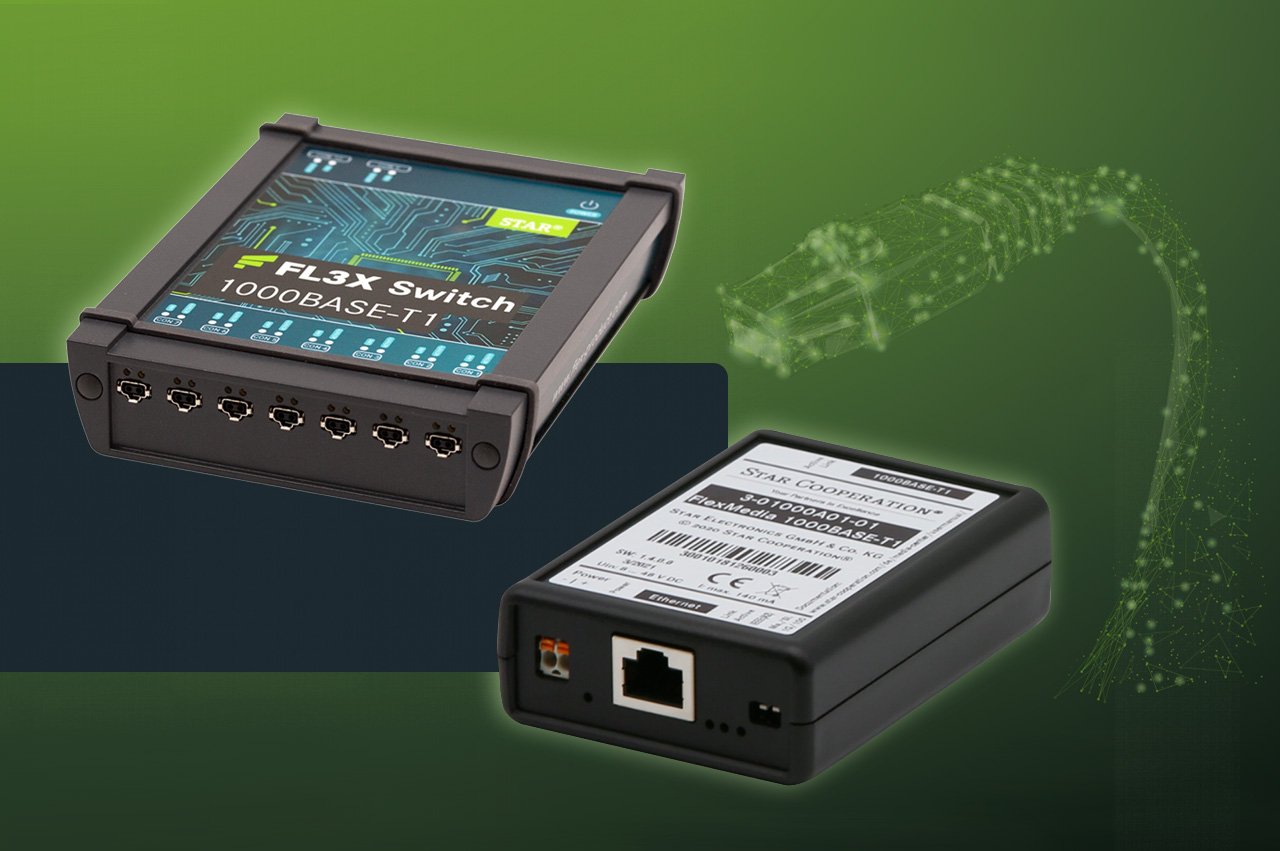
1000BASE-T1 Media Converters

These devices enable high-speed vehicle components - such as ADAS camera systems - to communicate with standard Ethernet infrastructure (e.g., laptops, servers, or diagnostic tools).
Example: FL3X Media 1000BASE-T1 – STAR ELECTRONICS


1000BASE-T1 Switches

Ideal for connecting low-to-medium bandwidth devices such as sensors, cameras, or ECUs within the vehicle network and for increasing the number of ports to connect more devices like simulation equipment, loggers and data analyzers.
Example: FL3X Switch 1000BASE-T1 – STAR ELECTRONICS

Practical Steps for a Stable and Secure Connection
  1. Use certified automotive converters and switches
    Choose hardware tested for harsh automotive conditions - including vibration, temperature fluctuations, and electromagnetic interference (EMI).

  2. Ensure high-quality shielding and connectors
    Good shielding preserves signal integrity and protects against interference.

  3. Rely on solutions without complicated configuration.
    Media converters and switches from STAR ELECTRONICS can be set up quickly and easily—without extensive setup.

  4. Validate network performance
    Run tests to ensure bandwidth, latency, and EMI tolerance meet the required specifications.

Real-World Applications
  • Test benches and development labs
    Quickly connect diagnostic tools with ECUs or camera systems in the vehicle.

  • ADAS validation environments
    Seamlessly link multi-gigabit camera systems to standard servers for data logging and analysis.

  • Infotainment and connectivity modules
    Developers can test and prototype features of Automotive Ethernet using existing Ethernet infrastructure.

Conclusion

Connecting traditional Ethernet with 100BASE-T1 and 1000BASE-T1 doesn’t have to be complicated. With certified media converters, automotive-grade switches, and plug-and-play solutions from STAR ELECTRONICS, engineers can build stable, secure, and efficient hybrid networks - simplifying development and validation processes.

Glossary

Term

Definition

Ethernet

Widely used networking technology for local area networks (LAN).

100BASE-TX / 1000BASE-T

Traditional Ethernet standards using two or four twisted pairs.

100BASE-T1 / 1000BASE-T1

Automotive Ethernet standards using a single twisted pair.

Twisted Pair

Cable type with two conductors twisted together to reduce EMI.

EMI

Electromagnetic interference that can affect signal quality.

ADAS

Advanced driver assistance systems like lane keeping or emergency braking.

ECU

Electronic control unit in vehicle.

Media Converter

Device that converts Ethernet signals between different standards.

Ethernet Switch

Network device that connects and manages multiple Ethernet components.

PoE

Technology that delivers power over Ethernet cables.

Plug-and-Play

Hardware that works immediately without manual configuration.

Summary

Ethernet Standard

Typical Connector

Number of Pins

Notes

100BASE-TX / 1000BASE-T

RJ45

8

Office/industrial networks

100BASE-T1 / 1000BASE-T1

Automotive connector

2

Vehicle networks, single twisted pair

Overview of BASE-T1 Standards and Cable Lengths

Standard

Data Rate

Max Cable Length

Notes

100BASE-T1

100 Mbps

up to 15 meters

For point-to-point connections in vehicles

1000BASE-T1

1 Gbps

up to 40 meters

Depending on cable type and environment

10BASE-T1S

10 Mbps

up to 25 meters

For multidrop networks (multiple participants)

Actual range depends heavily on factors such as cable quality, EMI environment, connector type, and signal processing. In the automotive industry, values are often conservatively chosen to ensure reliability under extreme conditions.

Contact us

Back to top